 Skip to content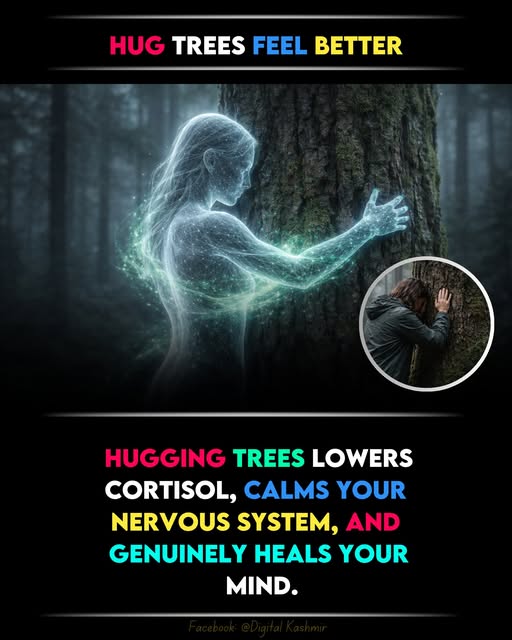
At first glance, the idea of hugging a tree might sound like something symbolic, spiritual, or even silly. But in recent years, scientists studying stress, mental health, and environmental psychology have discovered something very interesting: contact with nature really can influence how your brain and nervous system function.
While hugging a tree is not a medical treatment or a cure for anything, it sits inside a much larger and well-researched concept: how nature exposure helps regulate stress, attention, and emotional balance.
Let’s explore what science actually says, what is myth, and why so many people feel calmer after spending time around trees.
🧠 1. Your Brain Was Built for Natural Environments
Humans did not evolve in offices, cities, or under artificial lights. For most of human history, the brain developed in natural surroundings—forests, rivers, mountains, and open landscapes.
Because of this long evolutionary history, the brain is naturally tuned to respond positively to nature.
Research in neuroscience and environmental psychology shows that natural environments tend to:
- Reduce stress activation in the brain
- Lower mental fatigue
- Improve attention recovery
- Promote emotional stability
This is often referred to as the biophilia hypothesis, the idea that humans have an innate connection to nature.
🌿 2. What Happens in the Brain When You’re in Nature
When you are in a natural environment, several measurable changes can occur in the body:
🧠 Stress system slows down
Activity in the amygdala (the brain’s threat detection center) tends to reduce.
💓 Heart rate decreases
The parasympathetic nervous system becomes more active, promoting relaxation.
🌬️ Breathing becomes deeper
People naturally shift into slower, more regulated breathing patterns.
😌 Mental “noise” reduces
The brain has fewer artificial distractions to process.
Even short exposure—10 to 20 minutes—can produce noticeable effects.
🌲 3. The Science Behind Forest Therapy (Shinrin-Yoku)
A well-studied concept in this area is Shinrin-yoku, also known as “forest bathing,” developed in Japan.
Despite the name, it does not involve water. It simply means:
immersing yourself in a forest environment using all your senses.
Studies on forest bathing suggest it may:
- Reduce cortisol (stress hormone) levels
- Lower blood pressure
- Improve mood and emotional stability
- Enhance immune system markers
- Improve focus and cognitive clarity
The key factor is not physical exercise—it is slow, mindful exposure to nature.
🌳 4. Why Hugging a Tree Feels Calming (Psychological Reasons)
While there is limited direct scientific research on tree hugging specifically, the experience can still be explained through known psychological mechanisms.
🌿 1. Sensory grounding
Touching natural textures like bark engages your sense of touch, which helps bring attention into the present moment.
🧘 2. Mindfulness trigger
The act of stopping, pausing, and physically interacting with a tree interrupts mental overthinking.
🌬️ 3. Slow breathing response
People naturally slow their breathing when they pause in a quiet outdoor environment.
🌳 4. Symbolic safety cues
Trees are often associated with stability, growth, and life. These subconscious associations can influence emotional state.
🧠 5. Nature Reduces “Attention Fatigue”