 Skip to content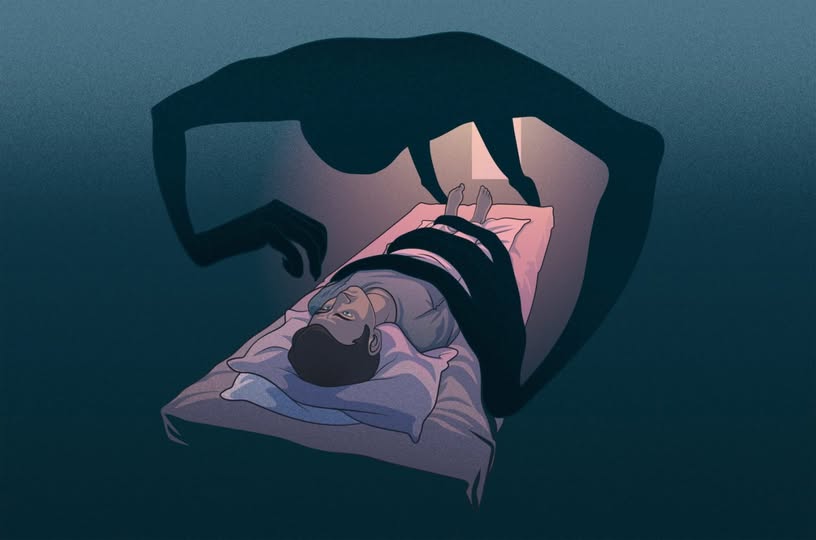
Many people around the world have experienced a strange and sometimes frightening phenomenon: waking up at night and being unable to move, speak, or react for a few seconds or even minutes. This condition is often described as “the body refusing to obey,” and medically it is known as sleep paralysis.
Although it can feel disturbing, sleep paralysis is a well-documented sleep phenomenon and is usually not dangerous. Understanding what it is and why it happens can significantly reduce fear and anxiety around it.
🧠 What is nocturnal immobility (sleep paralysis)?
Sleep paralysis occurs when a person becomes conscious while their body is still in a state of REM (rapid eye movement) sleep, the phase where dreaming happens.
During REM sleep:
- The brain is active (dreaming occurs)
- The body is temporarily “paralyzed” to prevent acting out dreams
Sleep paralysis happens when:
👉 The mind wakes up before the body “unlocks” from this natural paralysis state.
🧬 Why does the body become temporarily paralyzed?
This paralysis is actually a normal protective mechanism.
During REM sleep:
- Muscles are temporarily inactive
- Movement is blocked by the brain
- This prevents physical injury from acting out dreams
Sleep paralysis is simply a timing mismatch between brain awakening and muscle reactivation.
😨 What people typically experience
During an episode, a person may:
- Be aware of their surroundings
- Be unable to move or speak
- Feel pressure on the chest
- Experience a sensation of fear or panic
- Sometimes hallucinate (see or feel things that are not real)
These hallucinations are part of the dream state blending with wakefulness.
🧠 Why hallucinations can happen
The brain may still be partially in “dream mode,” leading to vivid sensory experiences such as:
- Feeling a presence in the room
- Seeing shadows or figures
- Hearing sounds or voices
These are not external realities—they are dream fragments overlapping with awareness.
⚖️ Common triggers of sleep paralysis
Several factors can increase the likelihood of episodes:
😴 1. Sleep deprivation
Not getting enough sleep disrupts normal sleep cycles.
🛏️ 2. Irregular sleep schedule
Sleeping at inconsistent times confuses the brain’s sleep regulation.
😟 3. Stress and anxiety
High stress levels can affect REM sleep stability.
💤 4. Sleeping on the back
This position is commonly associated with higher occurrence in some people.
🧠 5. Disrupted sleep cycles
Frequent waking during the night increases risk.
🧍♂️ Is it dangerous?