 Skip to content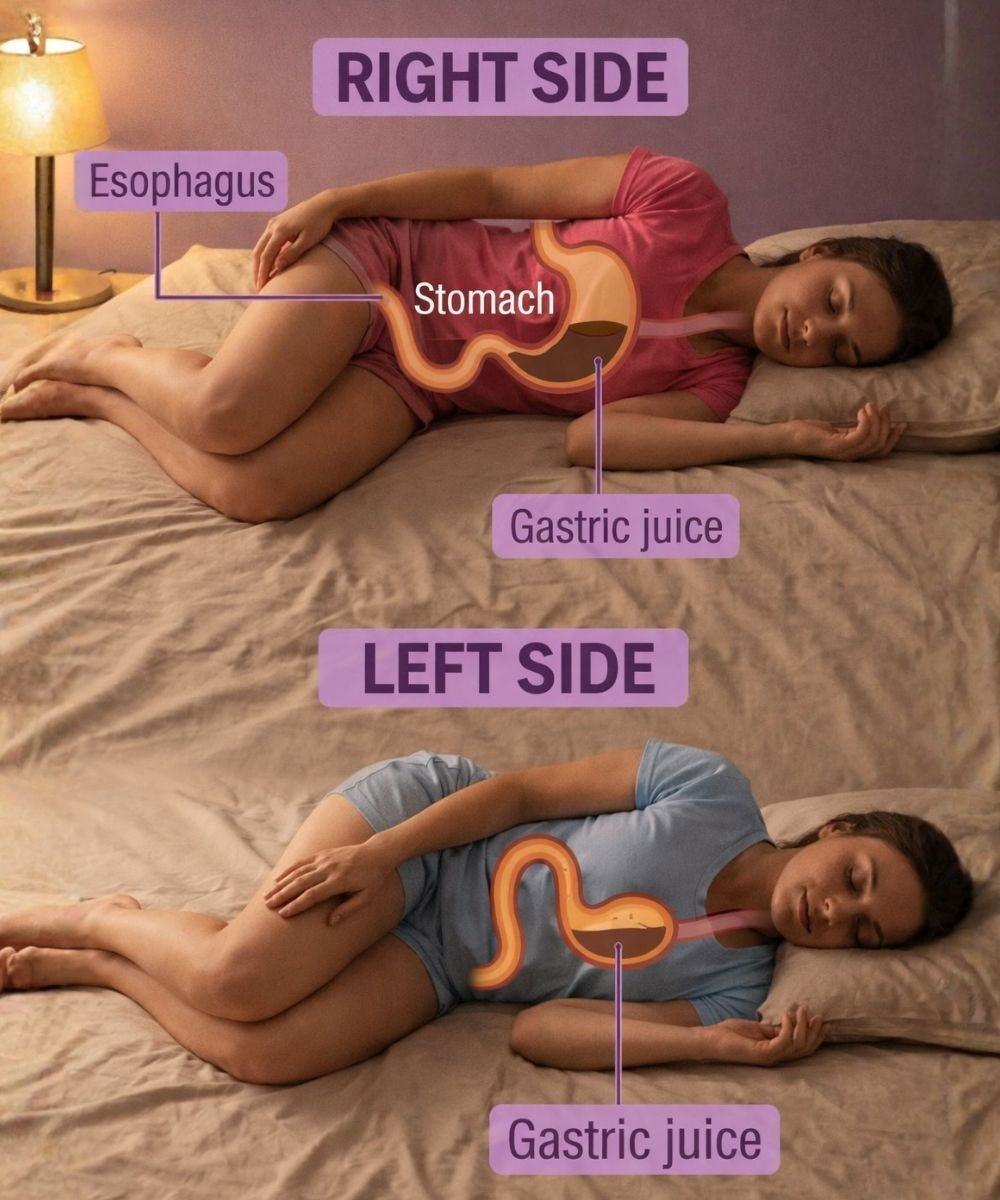
Sleep is one of the most essential pillars of good health, yet many people overlook how sleeping position can influence overall well-being. While most discussions focus on how long you sleep, fewer people realize that how you sleep—especially whether you lie on your right side—can have subtle but important effects on your body.
If you’re someone who naturally drifts off on your right side, you’re not alone. In fact, side sleeping is one of the most common sleep positions worldwide. But recent health insights suggest that your preferred side could impact digestion, heart function, and even how well you wake up in the morning.
Let’s explore what happens when you sleep on your right side—and whether it’s something you should reconsider.
🛌 Why Sleeping Position Matters More Than You Think
Your body doesn’t “shut off” when you sleep. Instead, it continues to carry out vital processes like digestion, circulation, and cellular repair. The position you choose can either support or hinder these functions.
Sleeping on your right side may feel comfortable, but your internal organs—including your stomach, liver, and heart—are positioned in ways that can respond differently depending on gravity and alignment.
❤️ Impact on Heart Function
One of the most talked-about concerns regarding right-side sleeping involves the heart. Because your heart is located slightly to the left side of your chest, sleeping on the right side may reduce pressure on it compared to lying on the left.
For some people, especially those with certain heart conditions, this might actually feel more comfortable. However, others report feeling increased awareness of their heartbeat when lying on the left side, which can be unsettling.
Still, for healthy individuals, there’s no strong evidence that sleeping on the right side harms the heart. In fact, comfort and uninterrupted sleep are often more important than the exact position.
🍽️ Digestion and Acid Reflux
This is where things get interesting. Your stomach is shaped in a way that makes gravity play a role in digestion.
When you sleep on your right side, the stomach may be positioned in a way that allows stomach acid to move upward more easily into the esophagus. This can increase the likelihood of acid reflux or heartburn, especially after eating late at night.
On the other hand, sleeping on your left side is often recommended for people who suffer from reflux, as it helps keep the stomach lower than the esophagus, reducing the chance of acid flow.
If you frequently wake up with a burning sensation in your chest or throat, your sleeping position could be a contributing factor worth adjusting.
🧠 Brain Health and Detox
During sleep, your brain clears out waste products through a system sometimes referred to as the “glymphatic system.” Some research suggests that side sleeping, in general, may support this process better than sleeping on your back or stomach.
However, the difference between left and right side sleeping in this context is still being studied. What matters most is that you’re getting deep, uninterrupted sleep cycles.
🤰 Special Considerations for Pregnant Women
Pregnant women are often advised to sleep on their left side rather than the right. This is because left-side sleeping can improve blood flow to the heart, fetus, and kidneys.
Sleeping on the right side during pregnancy isn’t necessarily dangerous in short periods, but consistently choosing the left side is generally considered more beneficial for circulation and nutrient delivery.
😴 Sleep Quality and Comfort