 Skip to content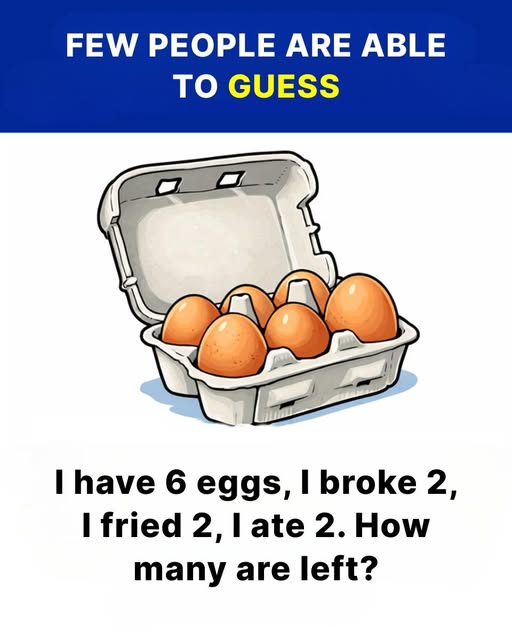
At first glance, this question feels confusing because it mixes different actions (breaking, frying, eating) and makes your brain think you are using more eggs than you actually have. But once you slow down and analyze it step by step, the answer becomes very clear.
This is not a real-world cooking problem—it’s a logic and wording puzzle.
🧠 Step 1: Understanding the Starting Point
The most important part of the question is:
👉 “I have 6 eggs”
This means you only start with six total eggs. Everything that follows must come from those same six eggs—there are no extra eggs added later.
So we establish:
- Total eggs = 6
🥚 Step 2: “I broke 2 eggs”
This does NOT mean you used additional eggs.
It simply describes what happened to some of the same eggs.
So:
- 2 eggs are broken (still part of the original 6)
- Remaining intact eggs = 4 (for now)
Important point:
Breaking eggs does not remove them from the total count. They are still part of the original six.
🍳 Step 3: “I fried 2 eggs”
Now comes the tricky part.
People often think:
- “Oh, frying means extra eggs are used”
But no—you are still talking about the SAME eggs.
So:
- 2 eggs were fried (already included in the original 6)
- These fried eggs may or may not overlap with the broken eggs (the question does not say they are different eggs)
This is where logic matters more than assumptions.
🍽️ Step 4: “I ate 2 eggs”
Again, same principle applies.
You are still working with the same original 6 eggs.
So:
- 2 eggs were eaten
- Those eggs are no longer available
Now we must subtract only the eggs that are actually consumed.
⚖️ Step 5: The Key Logical Insight
This puzzle is designed to confuse you by repeating actions on eggs, but all actions refer to the same original set.
So the only thing that actually removes eggs from the total is:
👉 Eating them (because they are no longer available)
Breaking and frying are states or actions, not additional eggs being removed from the set.
However, since the question doesn’t clearly separate eggs (like “different eggs were broken, fried, and eaten”), we assume overlap is possible.
🧮 Step 6: Final Calculation
Start:
- 6 eggs total
Eggs eaten:
- 2 eggs are eaten → these are gone
So:
- 6 − 2 = 4 eggs remaining
🥚 FINAL ANSWER: 4 eggs are left
🤯 Why This Puzzle Tricks People