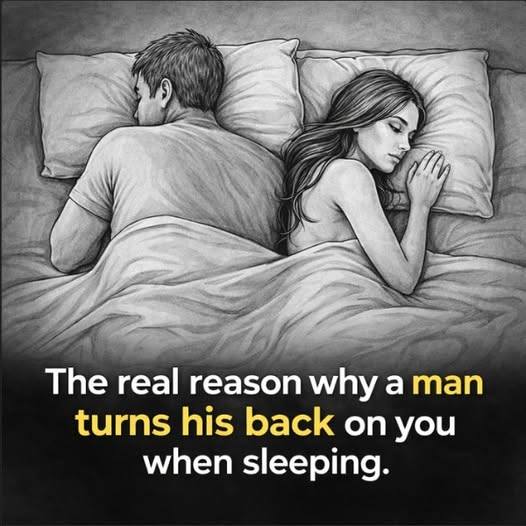
It’s a situation many people notice in relationships: you fall asleep next to your partner, everything feels fine, and later you wake up and realize he has turned his back on you. For some, this triggers worry, overthinking, or even emotional insecurity.
But here’s the truth most relationship myths ignore: sleep behavior is rarely emotional—it is mostly biological, automatic, and comfort-driven.
Let’s go deeper and understand what is really happening.
🧠 1. Sleep Position Is Controlled by Comfort, Not Emotions
When a person sleeps, the brain shifts into different sleep cycles. During these stages, the body naturally moves to find comfort.
Turning on the side or turning away is one of the most common positions because it:
- Reduces pressure on the chest and shoulders
- Helps the spine stay aligned
- Makes breathing easier
- Prevents discomfort from prolonged pressure
In simple terms, the body is not saying anything emotionally—it is simply adjusting to stay asleep comfortably.
🌡️ 2. Temperature Regulation Plays a Huge Role
One of the biggest reasons people turn away while sleeping is body heat regulation.
During sleep:
- The body naturally warms up
- Shared blankets trap heat
- Close contact increases temperature even more
So turning away helps:
- Cool the body down
- Improve sleep quality
- Prevent waking up from overheating
This is especially common in warmer climates or with thick bedding.
So what may look like “distance” is often just the body trying to avoid becoming too hot.
💤 3. The Brain Keeps Moving the Body During Sleep
Even though we are asleep, the brain is still active in controlling basic functions.
During deep sleep cycles:
- The body changes positions multiple times
- Movements happen unconsciously
- People may not remember moving at all
This is part of normal sleep architecture and is completely healthy.
A sleep-related pattern sometimes discussed in medicine is Parasomnia, which includes unconscious movements during sleep. In most people, these movements are harmless and natural.
🧠 4. Emotional Meaning Is Often Misinterpreted
In relationships, people naturally look for emotional meaning in behavior. So when a partner turns away, the mind may quickly think:
- “Is he upset?”
- “Did I do something wrong?”
- “Is he pulling away emotionally?”
But sleep behavior is not a communication tool. It is not intentional, symbolic, or controlled.
Most of the time, there is no emotional message at all.
❤️ 5. Feeling Safe Can Actually Increase “Distance”
This might surprise many people: in healthy, secure relationships, partners often sleep more freely—not more tightly.
When someone feels:
- emotionally safe
- comfortable in the relationship
- relaxed in their environment
They naturally stop controlling their sleeping position.
That means turning away can actually indicate comfort and trust, not rejection.
🧠 6. Stress, Fatigue, and Daily Life Also Affect Sleep
A partner’s sleep position can also be influenced by:
- Work stress
- Physical tiredness
- Emotional exhaustion
- Sleep quality issues
- Room environment (noise, light, temperature)
So what happens during sleep is often more connected to the day’s physical and mental load than to the relationship itself.
A broader condition sometimes associated with disrupted sleep patterns is Generalized Anxiety Disorder, which can affect sleep quality and movement during the night.
🛌 7. Humans Naturally Change Positions All Night
Studies show that most people:
- Move 10–40 times per night
- Switch positions multiple times
- Rarely stay in one position all night
So even if your partner turns his back, he may change position again later without even realizing it.
⚠️ 8. When Should You Actually Pay Attention?
 Skip to content